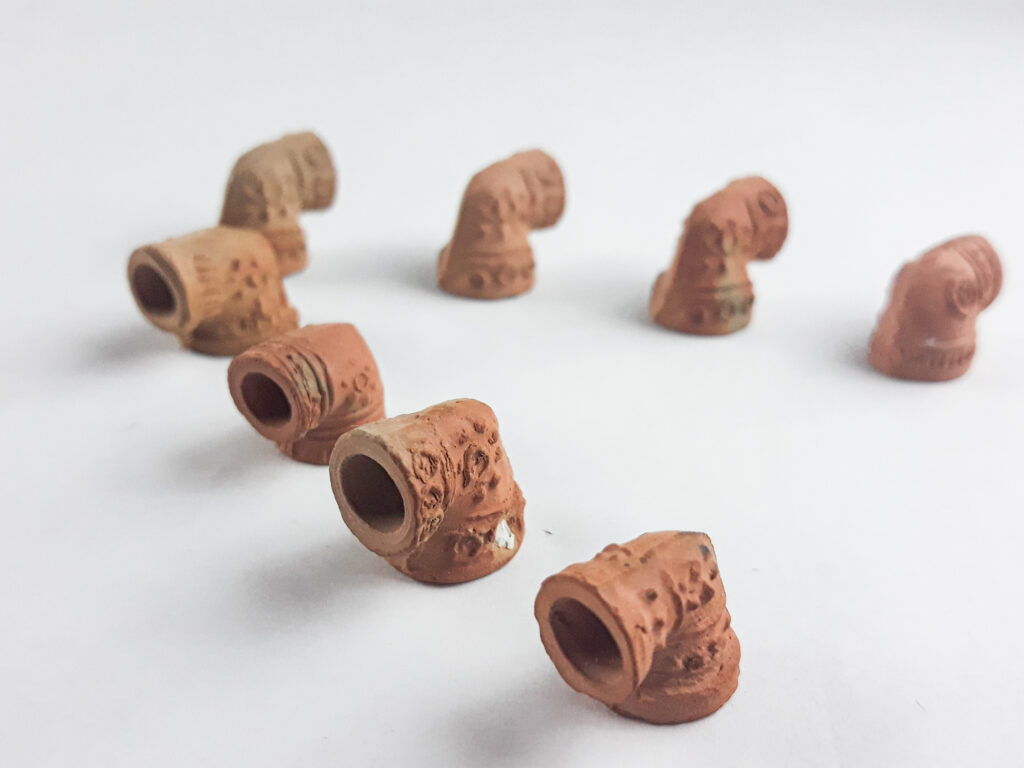
The shqaf is the working part of a sebsi and the part that gets replaced, which is why shops take them loose as well as paired. Each one is formed by hand rather than cast, so no two have quite the same wall thickness or seat.
The socket that takes the stem is the critical dimension. It is opened while the clay is still soft and sized by feel against a stem, then allowed to shrink as it dries and again in the firing. A potter working to a set of stems keeps a sample to test against, because clay that has shrunk too far cannot be opened back out.
Some are left plain and some are carved before firing, cut into the leather-hard clay when it will hold an edge but has not yet gone brittle. They are fired unglazed, and colour moves across a batch depending on where a piece sat in the kiln, so a box of them will never be one flat tone.